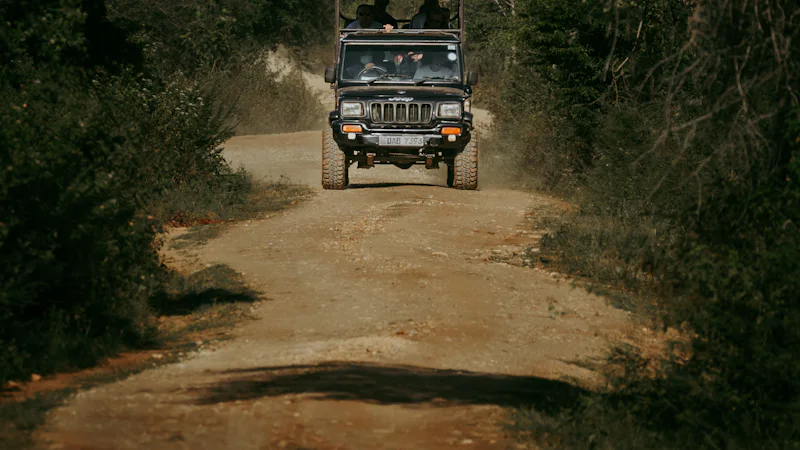
Child swimming in a resort pool lined with palm trees on a bright day

Travelling with children

Jim Corbett Family Resorts

A family Corbett trip succeeds or fails on the hours outside the jeep. Pool, lawn, shade, plain food on demand and a room layout that lets everyone sleep — those decide the holiday, not the room category.

Non-negotiables
Pool or lawn, shade, and a flexible kitchen
Room shape
Connecting or family rooms beat two separate bookings
Safari length
Roughly three hours — long for under-sevens
Best pace
Two nights, one or two shifts, one slow day

The short version

Where family Corbett trips actually go wrong

Very few family trips to Corbett are ruined by the safari. They are undone by the eighteen hours a day that are not the safari: a resort with nowhere for children to be, a kitchen that closes at ten, a room configuration that puts a toddler between two adults who both have to be awake at four, and an itinerary that assumed everyone would enjoy the same things.

The good news is that this is the easiest version of the Corbett stay problem to solve, because family requirements are concrete. Space to run, water to get into, shade to sit in, food children will eat, and rooms that let the group split. Properties either have these or they do not, and you can establish which in one conversation.

The safari itself needs a small adjustment rather than a rethink. A Corbett jeep shift runs about three hours on rough tracks with no stopping, which is a long time for a child under seven and a very long time for a child who did not want to come. Families who plan one good shift and keep the second optional almost always have a better trip than families who book three and force everyone through them.

There is also a version of this trip where not everybody goes on safari at all, and it works fine. One parent takes the older child on a morning shift; the other stays back with the younger one and the grandparents at the pool. Nobody is short-changed and nobody is bored in a jeep. Resorts on the Dhikuli belt are well set up for exactly this split.

The checklist worth insisting on

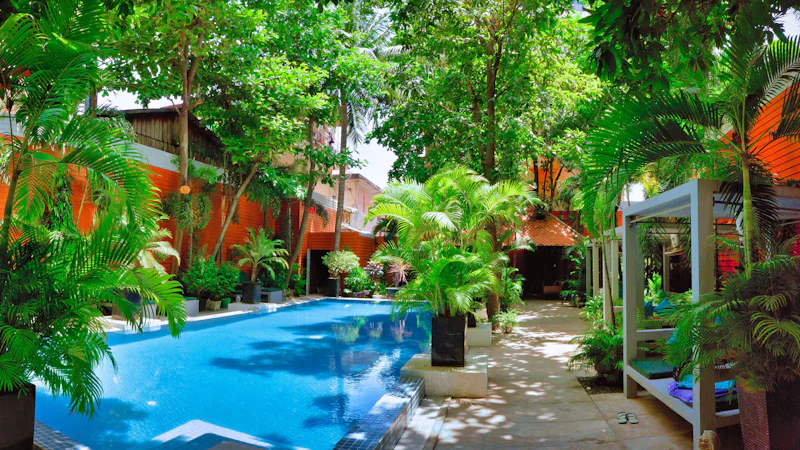
A pool with a shallow end and shade beside it. In April to June this is not a nice-to-have; it is what makes the middle of the day survivable. Confirm whether it is open in your month — some are closed in winter.

A lawn with a visible boundary. Children in an unfamiliar place with forest nearby need somewhere you can let them run without following them. This single feature does more for parental rest than anything else on the property.

Connecting or family rooms. Two rooms on different floors is a worse arrangement than one larger room, and much worse than two that connect. Ask specifically; "adjacent" is not "connecting".

A kitchen that will cook plain food outside meal hours. Safari timings wreck normal mealtimes. A property that will produce khichdi, plain parathas or toast at four in the afternoon is worth more than one with an elaborate buffet at eight.

Ground-floor access if grandparents are travelling. Many Corbett resorts are cottage-style and spread out, with steps and uneven paths. Check the distance from the room to the restaurant before you assume it is fine.

Ask about evening arrangements. Bonfire, board games, a lawn film or simply lighting that makes the grounds usable after dark. Corbett evenings are long and there is nothing else nearby.
What to look for

Features that earn their place on a family trip

Ranked roughly by how often their absence causes a problem.

01

Pool and poolside shade

The centre of gravity for the whole trip between March and June. Check the depth at the shallow end, whether it is supervised, and whether it is actually open in your travel month.

02

Enclosed lawn or garden

Somewhere children can be loose while adults sit down. Properties with a clear boundary are disproportionately more restful than properties with more square footage and no edge.

03

Flexible kitchen hours

Safari hours and children's hunger do not respect a buffet schedule. Ask whether simple food is available outside meal times and whether a packed early breakfast is possible.

04

Connecting family rooms

Lets adults take shifts on the early start without waking everyone. Confirm the word "connecting" explicitly rather than accepting "we will keep you together".

05

On-site activities

Cycling, nature walks, a bonfire, indoor games. Useful on the non-safari day when driving somewhere else is the last thing anyone wants.

06

Short drive to your gate

Every extra ten minutes in the dark is ten minutes less sleep for a child who will be difficult by ten in the morning. This matters more for families than for anyone else.

Side by side

Planning by age

A rough guide to what works, based on the trips that go smoothly.

Youngest child Safari plan Stay emphasis
Under 3 Skip or one short afternoon shift with one parent Pool, lawn, connecting rooms, flexible kitchen
3 to 6 One afternoon shift; keep the morning optional Space to run, early dinner, shaded outdoor seating
7 to 11 Two shifts is realistic; a morning shift works well Pool plus activities; a naturalist adds a lot
12 and over Full plan including an early morning shift Can prioritise location and safari quality over facilities
Mixed ages Split the group across shifts Property must work for both halves simultaneously

How it works

Planning a family trip properly

Start with the youngest

Their age sets the safari plan, and the safari plan sets the belt.

Filter on facilities, not photographs

Pool status, lawn boundary, connecting rooms and kitchen hours, all confirmed.

Build one slow day in

Two nights with one full unscheduled day beats three nights of activity.

Split the group where it helps

Not everybody has to do every safari. We time the transfers so that works.

FAQs

Questions people ask before booking

Is Jim Corbett safari suitable for young children?

A jeep shift is roughly three hours on rough tracks with no stopping, which most children under about seven find long. An afternoon shift is usually the kinder choice, and taking only one child while the other stays at the resort is a completely normal arrangement.

Is there a minimum age for the safari?

Small children are generally permitted, but the practical limit is temperament rather than a rule. Consider whether your child can sit still, cope with dust and cold air, and stay quiet when the vehicle stops.

Which resorts in Corbett are best for families?

The ones with a pool, an enclosed lawn, connecting rooms and a kitchen that will cook outside meal hours — most commonly found in the Dhikuli belt on the Ranikhet road. We shortlist against those four features rather than against star ratings.

How many nights should a family stay in Corbett?

Two nights is the practical minimum and three is noticeably more relaxed. With two nights, plan one safari shift and one completely unscheduled day rather than trying to fill both.

Do Corbett resorts have pools open in winter?

Many close or go unused from December to February because mornings are genuinely cold. If the pool is central to your plan, confirm it for your specific month rather than assuming.

Can we get plain food for children?

Most properties will manage it, but willingness outside fixed meal hours varies. Ask directly whether simple food is available in the afternoon and whether a packed pre-safari breakfast is possible.

Keep planning

Connected pages

The stay decision only works when it is made against the safari, the gate and the transfer. These pages cover the rest of it.

Jim Corbett Trip is a private travel assistance desk based in Ramnagar, not the official Corbett Tiger Reserve portal. Zone timings, permit rules and seasonal closures should be confirmed against the current official Corbett information before you book non-refundable travel.

Family planning

Tell us the ages and we will do the rest.

Children's ages change almost every recommendation we make — the belt, the property, the safari plan and the pace. Send them and we will build around them.

Shortlisted on pool, lawn, rooms and kitchen hours Safari plan matched to the youngest child Split-group transfers arranged where useful